
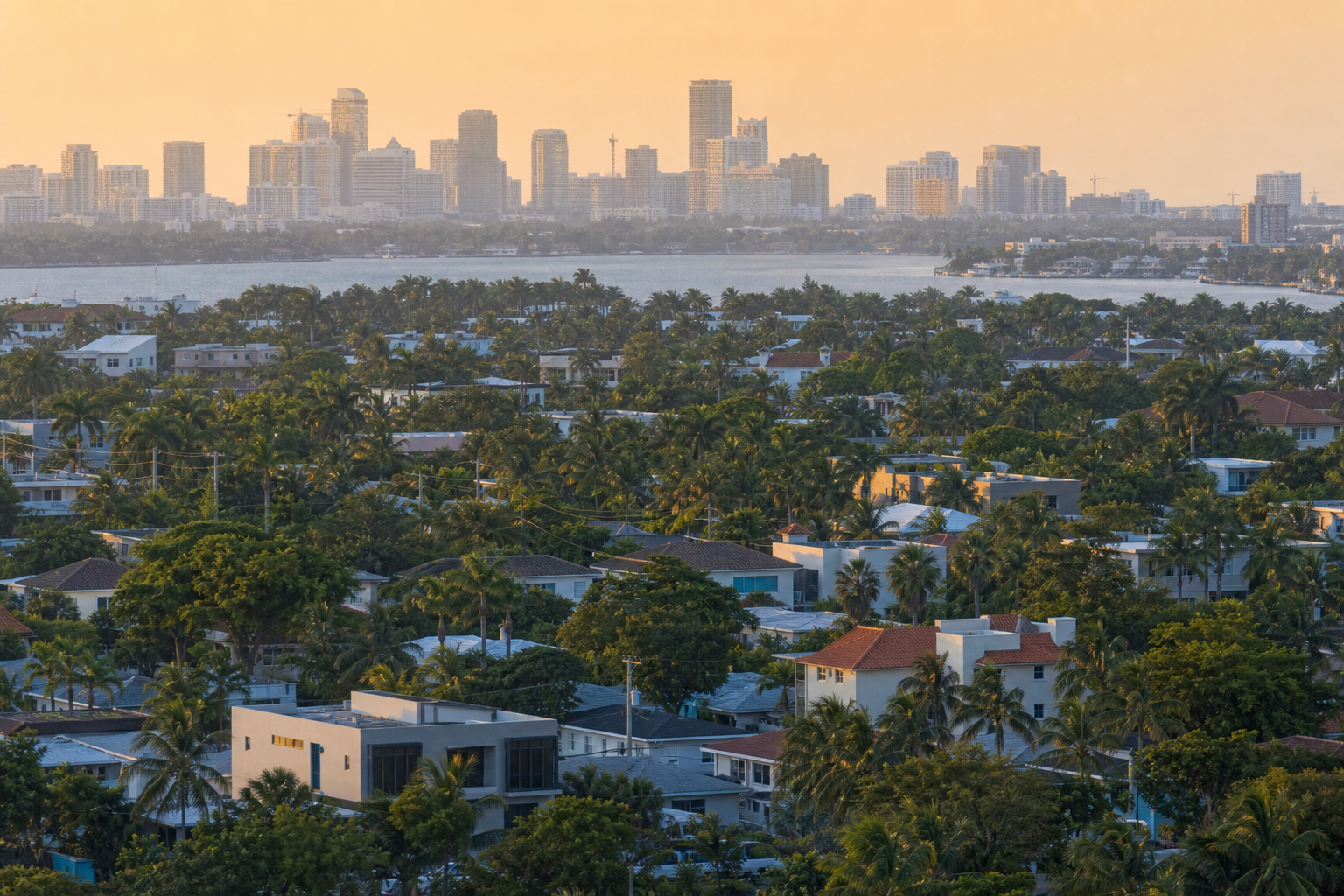
Broward County has shifted toward a buyer’s market in 2026, with longer days on market and rising inventory giving buyers more negotiating leverage, especially on condos and stale listings. The opportunity varies significantly by neighborhood, property type, and building, so selectivity matters more than timing alone.
Is Broward County a buyer’s market right now?
Broward County has moved into buyer’s market territory in 2026. Countywide median days on market reached 85 days in August 2026, according to Federal Reserve Bank of St. Louis FRED data, and inventory has built to a point where buyers have real options and real negotiating room. That said, this is not a uniform shift, the opportunity looks very different depending on whether you’re targeting a condo, a waterfront single-family home, or a neighborhood like Oakland Park versus Las Olas Isles.
Key Takeaways
- Broward County’s countywide median days on market hit 85 days in August 2026, a clear signal of a buyer’s market by historical standards.
- Recent local market data shows Wilton Manors homes sitting a median of 51 days before selling, with a median sale price of $587,500, but individual results vary by street, condition, and timing.
- The buyer’s market is most pronounced in the condo segment, where building-level diligence (reserves, insurance, assessments) is as important as the asking price.
- For single-family homes, leverage comes from targeting stale listings and properties with prior price reductions, not from treating every seller as distressed.
- Offer readiness, financing locked, search criteria defined, matters more than trying to time the exact best month to buy.
What does a buyer’s market actually mean for Broward buyers?
A buyer’s market means inventory is outpacing demand enough that buyers can negotiate, take their time, and make contingency-protected offers without automatically losing to competing bids. In Broward right now, that’s real, but it’s not evenly distributed.
The FRED countywide data gives you the macro picture. The neighborhood-level picture is more nuanced. Recent local market data across the areas I work most shows a wide range:
| Area | Median Sale Price | Median Days on Market |
|---|---|---|
| Wilton Manors | $587,500 | 51 |
| Oakland Park | $415,000 | 47 |
| Pompano Beach | $375,000 | 30 |
| Lighthouse Point | $715,000 | 51 |
| Victoria Park | $817,500 | 43 |
| Las Olas Isles | $4,820,500 | 46 |
| Coral Ridge | $1,650,000 | 54 |
| Poinsettia Heights | $697,000 | 40 |
These are area-level medians from aggregated public listing data, trailing roughly 90 days as of September 2026. An individual home’s value depends on its condition, street, build year, flood zone, and the specific timing of the sale. But the pattern is clear: even in a buyer’s market, Pompano Beach at 30 median days is a different conversation than Coral Ridge at 54.
Condos versus single-family homes
The buyer’s market is most pronounced in the condo segment. Fort Lauderdale has a heavy concentration of condominium inventory, and a combination of rising HOA costs, tightened insurance availability, and post-Surfside reserve-funding requirements has created real softness in some buildings. A lower asking price on a condo is worth exactly what the building’s financials say it’s worth, no more.
Before making an offer on any condo, I walk my clients through the association’s reserve funding status, any pending or recently levied special assessments, the building’s insurance situation, and whether the unit qualifies for conventional financing. Florida Realtors tracks the condo segment separately from single-family, and the divergence in 2026 is significant. A longer marketing period on a condo gives you time to do that diligence properly, use it.
For single-family homes, the opportunity is more selective. With roughly 4.2 to 4.3 months of supply in July and August 2026, buyers have leverage, but it’s concentrated in stale listings, homes with prior price reductions, and properties whose condition doesn’t match the asking price relative to nearby comparable sales. Not every single-family seller is under pressure. The ones who are tend to be visible: days on market climbing past 60, one or two price cuts already on the record, deferred maintenance showing in photos.
How to actually use a buyer’s market in Broward County
The buyers who benefit most from a buyer’s market aren’t the ones who wait the longest. They’re the ones who show up ready. Here’s the practical framework I use with clients entering this market.
Get your financing locked before you start touring
Even in a buyer’s market, a well-priced listing in a desirable neighborhood can draw multiple offers. Pre-approval isn’t a formality, it’s what lets you move when the right property appears. Know your maximum monthly payment before you know your maximum price. Your lender will tell you the number; your budget and your life will tell you what’s actually comfortable. Verify your numbers with your lender and factor in insurance, HOA fees, and property taxes specific to the property you’re targeting.
Target listings with leverage signals
In a buyer’s market, not every listing has equal negotiating room. The ones that do tend to share a few characteristics:
- Extended days on market. A home sitting 60-plus days has almost certainly had at least one internal pricing conversation. That’s your opening.
- Prior price reductions. A seller who has already cut the price is telling you something about their timeline and their flexibility.
- Condition gaps. When a listing’s asking price reflects a finished, move-in-ready home but the property clearly needs work, comparable sales become your most powerful tool.
- Insurance and flood-zone complications. Properties in higher-risk flood zones or with older roofs can carry insurance costs that affect what a buyer can realistically afford at a given price. That’s a negotiating data point, not a reason to walk away automatically.
Protect yourself with contingencies
One of the clearest signs of a buyer’s market is that inspection, financing, and appraisal contingencies are back on the table. During the peak seller’s market years, buyers routinely waived these to compete. Right now, in most Broward price ranges, you don’t have to. Keep them. An inspection contingency gives you the right to negotiate repairs or credits, or to walk, based on what the inspector finds. An appraisal contingency protects you if the property doesn’t support the agreed price. These are contract terms; your specific situation should be reviewed with a Florida-licensed real estate professional and your lender.
If you’re buying a condo, an association-review period is equally important. Florida law provides certain protections for condo buyers reviewing association documents, work through that process carefully, and have the financials reviewed by qualified advisers before you commit.
Use comparable sales, not list prices, as your anchor
In a buyer’s market, list prices are aspirational. What comparable homes have actually sold for, recently, in the same area, with similar condition and features, is what matters. I pull that data for every offer I write. It’s also what a lender’s appraiser will use, so anchoring your offer to real comps protects you from overpaying and keeps the deal from falling apart at appraisal.
For waterfront properties, the analysis gets more specific: canal width, ocean access, bridge clearance, seawall condition, and dockage all affect value in ways a countywide median can’t capture. If you’re targeting waterfront, take a look at my Broward County waterfront buyer’s guide for the additional factors worth evaluating.
And if you’re weighing whether Fort Lauderdale prices still have room to negotiate on the higher end, the post on negotiating Fort Lauderdale home prices in 2026 goes deeper on the luxury and upper-tier segment.
Every situation is different, and the only way to know what a specific property is actually worth, and how much room you have to negotiate, is to run the numbers with someone who knows this market. That’s exactly the conversation I have with every buyer before we write an offer.
If you’d like to read what past clients have said about working with me, my reviews are on Google and Zillow.
FAQ
Is Broward County officially a buyer’s market right now, or does it depend on the property type?
At the county level, Broward is in buyer’s market territory in 2026, the countywide median days on market reached 85 days in August 2026, according to Federal Reserve Bank of St. Louis data. The shift is most pronounced in the condo segment, while single-family homes in desirable neighborhoods still move faster and with less negotiating room. Property type, building condition, and neighborhood all matter significantly.
Are Fort Lauderdale condos a better buying opportunity than single-family homes in 2026?
Condos have more softness in 2026, driven by rising HOA costs, insurance challenges, and reserve-funding requirements, which means more negotiating room on price in some buildings. But a lower price is only an opportunity if the building’s financial condition supports it. Before offering on any condo, review the association’s reserves, any pending assessments, and the building’s insurability with qualified advisers.
Should I wait for prices to fall further before buying in Fort Lauderdale?
The available data does not establish a reliable month in 2026 when all Broward properties will sell at their lowest price. Waiting has a real cost, in rent, in rate movement, and in the listings you miss while watching. A more practical approach is to get financing locked, define what you’re looking for, and move when a property with real leverage signals appears. Offer readiness is more valuable than perfect timing.
Which Fort Lauderdale-area neighborhoods give buyers the most choice and negotiating leverage?
Recent local market data shows Coral Ridge at a median of 54 days on market, Wilton Manors and Lighthouse Point each at 51, and Victoria Park at 43, all areas where inventory has built enough to give buyers options. Oakland Park at 47 days and a median sale price of $415,000 offers a different value proposition for buyers who want proximity to Fort Lauderdale with more selection. Every neighborhood moves differently; the right choice depends on your priorities, budget, and property type.
Are sellers more willing to accept inspection repairs or credits in the current market?
Yes, in most Broward price ranges in 2026, inspection contingencies and post-inspection negotiations are back on the table in a way they weren’t during peak seller’s market conditions. Sellers with stale listings or prior price reductions tend to have the most flexibility. That said, a well-priced, well-maintained listing in a tight neighborhood can still attract competition, so don’t assume every seller is motivated to negotiate on repairs.
The buyer’s market in Broward County is real, and for prepared buyers it represents the most opportunity this market has offered in several years. The key is knowing where the leverage actually lives, by neighborhood, property type, and individual listing, and showing up ready to act on it.
If you want to walk through what this means for your specific search, schedule a conversation with me here. I handle every client personally, and I’ll give you a straight read on what the data says about the properties you’re considering.
Equal Housing Opportunity. Scott Morreau, P.A., Broker Associate, Real Broker, LLC (Licensed since 2001), regulated by the Florida Real Estate Commission. This article is general information only and does not constitute legal, tax, or financial advice, confirm your specific numbers with your title company, tax advisor, or lender. Real Broker, LLC main office: 8291 Championsgate Blvd., Championsgate, FL 33896. Office at 2312 Wilton Drive is not a registered branch office and is not open to the public; meetings by appointment only.