
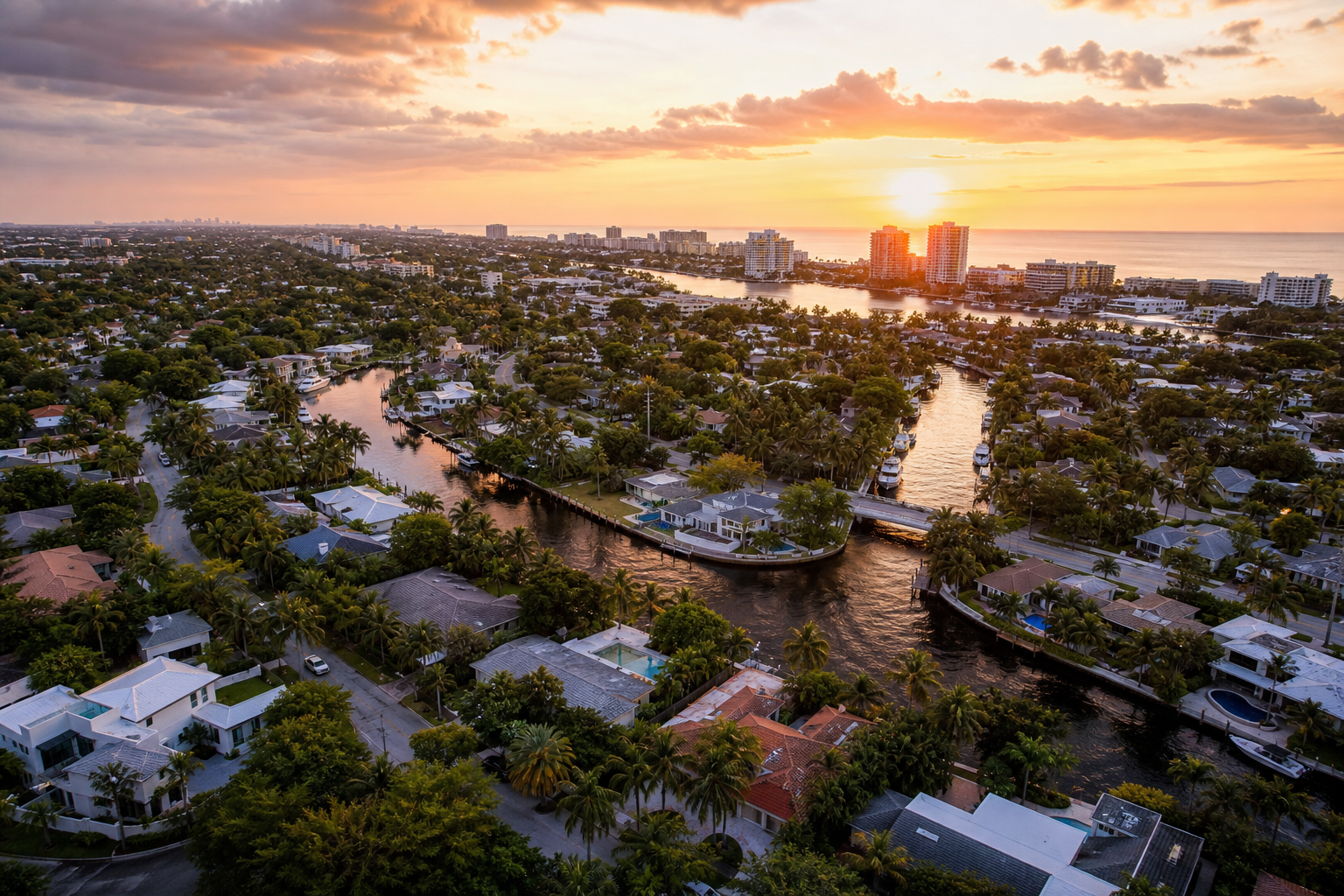
Fort Lauderdale and Broward County waterfront homes are seeing rising prices and faster sales in 2026, with ocean-access single-family sales up 18% year-over-year and a median of $2.6M for Fort Lauderdale waterfront. Buyers who understand canal access, seawall condition, and neighborhood price tiers can find real opportunities in this segmented market.
Is buying a waterfront home in Broward County a smart move in 2026?
Yes, for buyers who go in with the right information. Fort Lauderdale waterfront recorded 192 single-family transactions in the first half of 2026 alone, with a median sale price of $2.60 million and total volume near $760.7 million. Ocean-access sales across Northeast Broward rose 18% year-over-year, and the median price per square foot climbed to $829. That’s a market with real momentum, and it rewards buyers who know where the leverage still exists.
What’s Actually Driving Waterfront Growth in Broward Right Now
Fort Lauderdale has long carried the nickname “the Venice of America” for good reason. The city’s network of navigable canals, ocean inlets, and marina infrastructure creates a category of real estate that doesn’t exist most places in the country. And in 2026, demand for that access has only intensified.
According to the most recent waterfront data available, the median sale price for ocean-access homes in Northeast Broward rose 9.6% year-over-year to $2.0 million, while the Fort Lauderdale-specific waterfront segment posted a median of $2.60 million across 192 closings in just the first six months of 2026. The average sale price hit $3.96 million, which tells you the upper tier is pulling hard on that number.
I’ve written more about the marina infrastructure behind these trends over at my post on Fort Lauderdale marina growth and waterfront real estate, the public and private investment in Broward’s boating corridors is a long-term value driver that shows no sign of slowing.
For context on how this fits into the broader economy, the downtown Fort Lauderdale economic expansion has pulled high-income residents and businesses into the area, and waterfront access is consistently one of the top priorities for that buyer pool.
Where prices stand across the market today
Waterfront carries a significant premium over the broader market. Recent local market data across Greater Fort Lauderdale’s key areas shows the full range of what buyers are working with right now:
| Area | Median Sale Price | Median Days on Market |
|---|---|---|
| Wilton Manors | $575,000 | 51 |
| Oakland Park | $380,000 | 47 |
| Pompano Beach | $352,500 | 23 |
| Lighthouse Point | $880,000 | 51 |
| Victoria Park | $907,500 | 54 |
| Las Olas Isles | $4,853,000 | 45 |
| Coral Ridge | $1,515,000 | 50 |
| Poinsettia Heights | $627,500 | 38 |
These are area-level medians from aggregated public listing data trailing roughly 90 days as of August 2026. An individual home’s value shifts based on street, canal access, build year, and condition. Las Olas Isles at a $4.85M median and Coral Ridge at $1.515M reflect the waterfront premium clearly. Lighthouse Point and Victoria Park sit in a compelling mid-tier range for buyers who want navigable water without the full ultra-luxury price tag.
The segmentation that matters most to buyers
Not all waterfront is created equal in Broward. The market breaks into roughly two tiers:
- Mid-tier waterfront (roughly $2.0M to $2.6M median): Active turnover, rising prices, and conditions that lean toward sellers. These are the properties moving in 45-50 days or less, often with multiple serious inquiries.
- Ultra-luxury waterfront ($4.5M and above): Slower absorption, longer days on market, and meaningfully more room for negotiation. Sellers at this level have often priced with a cushion, and patient buyers can work with that.
Knowing which tier you’re shopping in changes your entire strategy. I walk every waterfront buyer I work with through exactly this breakdown before we start touring, because the approach is completely different depending on the price point.
What to Evaluate Before You Make an Offer
Waterfront purchases carry due-diligence requirements that don’t come up in a standard single-family transaction. Here’s what I tell buyers to focus on:
Canal access and navigability
For boating buyers, this is the non-negotiable. Canal depth, bridge clearance, and proximity to an inlet determine what you can actually do with the property. A beautiful home on a canal that can’t accommodate your boat is a lifestyle mismatch, not a deal. I always recommend buyers with specific vessel requirements get a water-depth assessment and verify bridge heights before falling in love with a listing.
According to data and local expertise detailed in the Fort Lauderdale marina growth report, navigability and ocean access are among the most durable long-term value drivers in Broward’s waterfront corridors. Cosmetic updates come and go. Water access doesn’t change.
Seawall and dock condition
This is where buyers find both risk and opportunity. An older or deteriorating seawall is a significant repair cost and a negotiating point. But properties with seawall issues or dated docks often price below turnkey listings on the same canal, which is exactly where a prepared buyer can find value.
The Seller’s Property Disclosure used in most Broward County waterfront transactions covers seawall condition, any known settlement or prior repairs, dock configuration, boat lift permits, and known limitations on navigability. Read it carefully and, if anything is unclear, get a qualified marine contractor to inspect the seawall and dock independently. That inspection cost is small relative to what a failing seawall can run.
Flood zone and insurance disclosures
Florida waterfront properties sit in FEMA-designated flood zones, and the insurance picture matters as much as the purchase price. Sellers of canal-front and waterfront properties in Broward commonly provide a Seller Flood Disclosure or flood-risk addendum covering the current flood insurance policy (and whether it’s transferable), the FEMA flood zone designation, any elevation certificate details, and the history of flood events or water intrusion beyond normal storm activity.
The FEMA Flood Map Service Center lets you look up a property’s flood zone designation before you make an offer. Do it. And verify current flood insurance costs with your insurer directly, because the FEMA Risk Rating 2.0 methodology has changed how premiums are calculated, and that number affects your total carrying cost.
Title search and the closing process
In Broward County, a title company handles the closing and conducts the title search, which on a waterfront property includes checking for municipal liens, HOA and dock or permit issues, and any recorded easements related to seawall or canal maintenance. The title company also coordinates payoffs for any existing mortgages, special assessments, or contractor liens tied to waterfront improvements, and prepares the settlement statement.
Florida imposes a documentary stamp tax on deeds at a statutory rate of $0.70 per $100 of consideration, per the Broward County Records, Taxes and Treasury Division fee schedule. Whether the buyer or seller pays this is typically negotiated in the contract rather than fixed by statute, so confirm how it’s allocated in your specific purchase agreement. The Florida Department of Revenue’s documentary stamp tax guidance is worth reviewing for the full statutory framework.
For a broader look at what buyers navigating the luxury end of this market should expect in negotiations, my guide on how to negotiate luxury home prices in South Florida covers the tactical side in depth.
Where Buyers Can Still Find Leverage in 2026
The mid-tier waterfront market is competitive, but it isn’t uniform. Here’s where I consistently see buyers with the right preparation come out ahead:
- Properties with deferred seawall or dock maintenance. These often price below turnkey comps on the same canal. If you have a realistic repair budget and a contractor you trust, this is one of the clearest paths to buying below market value in an otherwise tight segment.
- Dated interiors on strong lots. A home with a great canal position, good depth, and close inlet access but a 1990s kitchen will sit longer than a renovated comparable. That’s your window.
- The ultra-luxury tier above $4.5M. As the days-on-market data shows, these properties move slowly. Sellers have priced in a negotiation buffer more often than not. A patient, well-represented buyer has real room to work here.
- Areas outside the top-tier corridors. Pompano Beach’s waterfront segment, for example, offers ocean-access properties at meaningfully lower entry points than Las Olas Isles or Seven Isles. The boating access is real; the price premium is smaller.
Your specific opportunity depends on your timeline, budget, and what you actually need from the water. That’s a conversation worth having before you start touring, not after. Every waterfront purchase I’ve handled has required a different approach, and the only way to map out yours is to run the numbers on your actual situation.
If you’re relocating to the area and approaching this market from outside South Florida, my Fort Lauderdale relocation guide gives broader context on neighborhoods and the local buying process.
Frequently Asked Questions
Is Fort Lauderdale waterfront real estate still a good investment in 2026, or are prices too high?
The data suggests continued strength rather than a ceiling. Ocean-access sales in Northeast Broward rose 18% year-over-year in the first half of 2026, with the median price climbing 9.6% to $2.0 million. That said, “good investment” depends entirely on the specific property, canal access, and your hold strategy. The ultra-luxury tier above $4.5M shows slower absorption and more negotiating room, while mid-tier waterfront is moving faster and leaving less margin for buyers who aren’t prepared.
What should I look for in a seawall and dock when buying a waterfront home in Fort Lauderdale?
Start with the age and material of the seawall, any visible cracking, settlement, or prior repair history, and whether there are active permits for the dock or boat lift. The Seller’s Property Disclosure will cover known issues, but an independent inspection by a licensed marine contractor is worth every dollar on a waterfront purchase. Properties with seawall or dock issues often price below turnkey listings on the same canal, which can be an opportunity if you go in with eyes open and a realistic repair budget.
Do I have to pay Florida documentary stamp tax as the buyer, or can the seller pay it?
Florida’s documentary stamp tax on deeds is a statutory charge at $0.70 per $100 of consideration, fixed by state law and confirmed in the Broward County fee schedule. Who actually pays it, buyer or seller, is typically negotiated in the purchase contract rather than mandated by statute. Local custom in Broward County leans a particular direction, but your contract controls it. Confirm the allocation in your specific agreement with your title company.
Which neighborhoods in Greater Fort Lauderdale have the best ocean-access canals for boating buyers?
Las Olas Isles, Seven Isles, Coral Ridge, and Rio Vista are among the most sought-after corridors for deep-water ocean access, with Las Olas Isles carrying a median near $4.85M reflecting that demand. Lighthouse Point offers strong boating access at a lower median than the Las Olas corridor. Pompano Beach’s waterfront segment provides genuine ocean access at a more accessible price point. Canal depth, bridge clearance, and inlet proximity vary street by street, so a local agent with waterfront-specific experience is essential before you narrow your search.
How fast are waterfront homes selling in Fort Lauderdale compared to non-waterfront properties?
Mid-tier waterfront properties in Fort Lauderdale are moving in roughly 45 to 54 days based on recent local market data, which is broadly in line with the broader Greater Fort Lauderdale market. The meaningful difference is in the ultra-luxury waterfront tier, where slower absorption and longer days on market give buyers more negotiating leverage. Pompano Beach across all property types is moving notably faster at a 23-day median, suggesting strong demand at lower price points in that market.
Fort Lauderdale’s waterfront market in 2026 is active, price-competitive at the mid-tier, and still full of opportunity for buyers who know where to look and what to evaluate. The difference between a great waterfront purchase and an expensive lesson usually comes down to preparation and local expertise.
I’ve spent more than 20 years navigating Broward County’s waterfront corridors with buyers at every price point. If you’re ready to talk through what’s available, where the leverage is, and what your search should actually look like, schedule a conversation with me here and we’ll map it out.
This article is general information only and does not constitute legal, tax, or financial advice. Confirm your specific costs, tax obligations, and transaction details with your title company, tax advisor, or lender. Scott Morreau, P.A., Broker Associate, Real Broker, LLC (Licensed since 2001). Regulated by the Florida Real Estate Commission. Real Broker, LLC main office: 8291 Championsgate Blvd., Championsgate, FL 33896. Meetings by appointment only. Equal Housing Opportunity.