
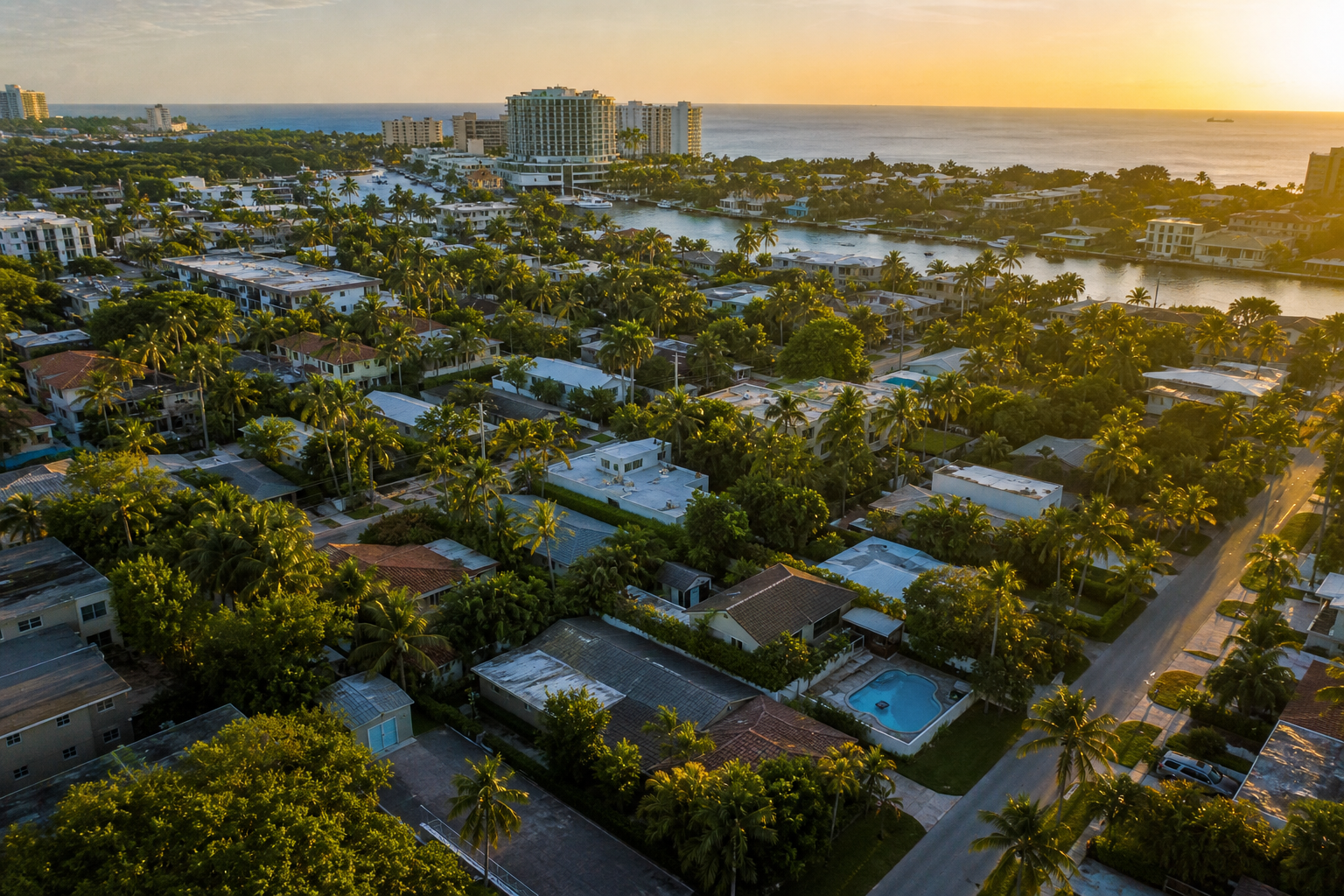
A 1031 exchange lets Fort Lauderdale investors defer federal capital gains taxes by reinvesting sale proceeds into a like-kind replacement property. You must identify a replacement within 45 days and close within 180 days, working with a qualified intermediary before your relinquished property closes.
How does a 1031 exchange work for investment property in Fort Lauderdale?
A 1031 exchange, governed by Internal Revenue Code §1031, lets you defer federal capital gains taxes when you sell an investment or business property and reinvest the proceeds into a like-kind replacement. In Greater Fort Lauderdale, that means you can sell a legacy rental, a waterfront duplex, or a commercial property and roll your equity into a higher-performing asset without writing a check to the IRS at closing. The deferral is not forgiveness, it follows the property, but for investors building long-term wealth, deferring that tax bill while compounding equity is one of the most powerful tools available.
Here is the short version of how it works in Florida: your sale proceeds never touch your hands. A qualified intermediary (QI) holds the funds between the sale of your relinquished property and the purchase of your replacement. Your title company handles the local closing mechanics in Broward County, and the QI handles the IRS compliance side. Both have to coordinate precisely, or you lose the deferral.
The Rules, the Timelines, and What Fort Lauderdale’s Market Means for Both
The deadlines you cannot miss
The two hard deadlines under IRC §1031 are non-negotiable and do not vary by state:
- 45 days from the closing of your relinquished property to identify replacement properties in writing to your QI.
- 180 days from that same closing date to close on one or more of your identified replacement properties.
Miss either deadline and the exchange fails. The entire gain becomes taxable in the year of the sale. There are no extensions for market conditions, financing delays, or negotiation snags.
That makes local market timing genuinely relevant. According to Redfin’s Q2 2026 data, homes in Fort Lauderdale sold in around 97 days on average during the three months ending June 2026. That is slower than the 91-day pace the prior year, which actually gives exchange investors a bit more breathing room on the replacement side. Recent Zillow market data shows Wilton Manors running at a 26-day median days on market, while Oakland Park sits closer to 54 days. The range matters: if you are targeting a specific submarket as your replacement, you need to know how fast (or slow) it moves before you commit to your identification list.
What qualifies, and what does not
After the 2017 Tax Cuts and Jobs Act, 1031 exchanges are limited to real property. Personal property no longer qualifies. Your primary residence does not qualify. Property held primarily for resale (fix-and-flip inventory) does not qualify. What does qualify: investment real estate and business real estate held for productive use. In Greater Fort Lauderdale, that covers single-family rentals, small apartment buildings, commercial properties, waterfront investment condos, and mixed-use buildings, a wide universe for repositioning a portfolio.
The Fort Lauderdale market picture heading into the exchange
Understanding where the market stands shapes both the decision to sell and the identification strategy. The most recent data paints a nuanced picture. According to Redfin, the median sale price in Fort Lauderdale for Q2 2026 was $580,000, up 10.4% year-over-year. At the same time, Zillow’s July 2026 data puts the average home value at $513,820, reflecting a 1-year change of -2.2%, with a median sale price of $541,000 and a median sale-to-list ratio of 0.951. And Realtor.com reported that as of June 2026, homes sold roughly 5% below asking on average.
Those figures are not contradictory, they reflect different data windows and methodologies. What they collectively tell an investor: appreciation has been strong in certain segments, buyers have negotiating room in others, and the market is not so frenzied that the 45-day identification window becomes impossible to work with.
Here is a current area-level snapshot from recent Zillow market data (trailing approximately 90 days, as of August 2026). Individual property values vary by condition, street, build year, and timing.
| Area | Median Sale Price | Median Days on Market |
|---|---|---|
| Wilton Manors | $458,000 | 26 |
| Oakland Park | $390,000 | 54 |
| Las Olas Isles | $4,465,000 | 56 |
| Poinsettia Heights | $630,000 | 36 |
For an investor doing a 1031 exchange, this kind of area-level data informs both sides of the transaction. A legacy single-family rental in a high-appreciation submarket may be the right asset to relinquish. A multifamily property in a submarket with stronger rental demand and a longer days-on-market may be the right replacement. Matching the exchange strategy to current inventory conditions is exactly the kind of local work I do with investment clients before we ever list the relinquished property. For a deeper look at specific asset types worth targeting, see my post on 1031 exchange strategies and the best Fort Lauderdale investment properties to sell and buy in 2026.
The Step-by-Step Process for a Fort Lauderdale 1031 Exchange
Step 1: Confirm eligibility with your tax advisor before anything else
The first call is to your CPA or tax advisor, not your real estate agent. Confirm the property is held for investment or business use, estimate the gain and depreciation recapture that would be triggered without an exchange, and verify that a 1031 exchange is the right strategy for your situation. That conversation shapes every decision that follows.
Step 2: Engage a qualified intermediary before closing
The QI must be in place before the relinquished property closes. If sale proceeds pass through your hands, even briefly, the exchange is disqualified. The QI is not your agent, your attorney, or your title company. It is a separate, specialized company whose sole function is to hold the exchange funds and document the transaction for IRS purposes. Several Florida-based QI firms operate in the Greater Fort Lauderdale market. Your CPA can recommend one; so can I.
Step 3: List and contract the relinquished property
This is where I come in on the sell side. The listing process for an investment property in Fort Lauderdale includes the standard seller’s property disclosure and, for coastal or flood-zone properties, a flood-risk disclosure addressing flood history, insurance requirements, and elevation. These are standard practice in Broward County given our coastal geography, and they affect buyer perception and insurability, both of which influence how quickly you close and at what price.
Step 4: Coordinate the closing with your title company and QI
In Florida, a title company handles the closing: title search, lien clearance, deed and mortgage preparation, recording with Broward County, and issuance of title insurance policies. For a 1031 exchange, the title company and QI coordinate at closing so that sale proceeds flow directly to the QI, never to you. The Florida documentary stamp tax on deeds, currently $0.70 per $100 of consideration, applies to the conveyance and is paid to Broward County at closing. How doc stamps and other closing costs are allocated between buyer and seller is typically negotiated in the contract, not set by law, so confirm the specifics in your own agreement.
Step 5: Identify replacement properties within 45 days
You have 45 days from the closing of the relinquished property to submit a written identification of replacement properties to your QI. The IRS allows you to identify up to three properties regardless of value, or more properties under certain valuation rules. In Greater Fort Lauderdale’s current market, with active inventory across segments and days on market ranging from the mid-20s to nearly 100 days depending on the submarket, having a shortlist of two or three well-researched candidates before you even close the relinquished property is the right approach. Waiting until after closing to start looking is how investors miss the deadline.
Step 6: Close on the replacement property within 180 days
The replacement closing follows the same Fort Lauderdale process: title company, QI funds applied directly to the purchase, deed recorded with Broward County, documentary stamp tax paid on the acquisition. The exchange is complete. Your capital gains tax is deferred, and your equity is repositioned into the new asset.
Every step in this sequence has a dependency on the one before it. The investors I work with who execute cleanly are the ones who have the QI engaged, the tax advisor briefed, and a target replacement asset in mind before the relinquished property hits the market. If you are still at the “should I do this?” stage, that is exactly the conversation to have with me before anything else moves. You can schedule a consultation here.
Frequently Asked Questions
Can I use a 1031 exchange to sell my Fort Lauderdale rental and buy a waterfront condo or multifamily property here?
Yes, as long as both properties are held for investment or business use and meet the like-kind requirement under IRC §1031. Trading a single-family rental for a multifamily building, a waterfront investment condo, or even a mixed-use property all qualify, provided you are not buying the replacement as a primary residence or for personal use. The key is intent: the replacement property must be held for investment or productive business use.
Do the 45-day and 180-day deadlines change for Florida or Greater Fort Lauderdale?
No. The timelines are federal under IRC §1031 and apply uniformly nationwide. Florida has no state-level modification. What changes locally is how market conditions affect your ability to find, negotiate, and close on a replacement within those windows. In Greater Fort Lauderdale’s current environment, with median days on market ranging from roughly 26 to 97 days depending on the submarket, most investors can work within the 180-day window, but only with careful advance planning and a clear target property list before the relinquished property closes.
How does Florida’s documentary stamp tax affect a 1031 exchange in Broward County?
The Florida documentary stamp tax on deeds applies to both the sale of your relinquished property and the purchase of your replacement, it is a transfer tax on the conveyance itself, not on gain. At $0.70 per $100 of consideration statewide, it is a closing cost to plan for on both sides of the exchange. It does not affect your federal tax deferral under §1031, but it is a real cash item at each closing. How it is allocated between buyer and seller is typically negotiated in the contract.
Do I need a special title company to handle a 1031 exchange closing in Fort Lauderdale?
Not a specially licensed one, but you want a title company with experience coordinating 1031 exchange closings. In Greater Fort Lauderdale, the title company handles the local closing mechanics, title search, deed recording, documentary stamp tax, title insurance, while a separate qualified intermediary holds the exchange funds and manages IRS compliance. The two have to coordinate precisely at closing so proceeds never pass to you. I can point you toward title companies in Broward County that handle exchange closings routinely.
What local market risks should a Fort Lauderdale investor weigh before committing to a 1031 exchange?
The main risk specific to this market right now is the mixed pricing signals. Redfin’s Q2 2026 data shows a 10.4% year-over-year median price increase, while Zillow’s July 2026 figures show a 1-year average value decline of 2.2%. Some broader metro analytics characterize the area as overvalued. That divergence means the segment you are selling into and the segment you are buying into may be at very different points in their cycles. A 1031 exchange locks you into a 45-day identification window, if the replacement market you are targeting is moving fast or inventory is thin, you may end up overpaying to close on time. That is why the replacement strategy has to be mapped out before the relinquished property closes, not after.
The right exchange strategy depends on your specific portfolio, your tax situation, and the exact assets you are trading. Book a conversation with me and we will map out both sides before you commit to anything.
Equal Housing Opportunity. Scott Morreau, P.A., Broker Associate, Real Broker, LLC (Licensed since 2001), regulated by the Florida Real Estate Commission. Real Broker, LLC main office: 8291 Championsgate Blvd., Championsgate, FL 33896. Office at 2312 Wilton Drive is not a registered branch office and is not open to the public; meetings by appointment only. This article is general information only and does not constitute legal, tax, or financial advice. Confirm your specific numbers and exchange structure with your qualified intermediary, CPA, title company, and legal advisor. Broker fees and commissions are fully negotiable and not set by law.